Where should a student summer camp be held? 8 criteria for choosing the right experiential centre & why Eduland Ba Vi camping tour is Hanoi's top choice in 2026.
Every summer, thousands of schools and parents across Hanoi ask the same question: where should we hold the student summer camp this year? It is not an easy question — because behind it lies a series of very real concerns: will it be safe, will the activities suit the age group, will the cost be reasonable, and most importantly — will the trip genuinely give students something valuable, or will it just be another outing that ticks a box?
The truth is: not every destination is suited to a student summer camp. A beautiful resort does not necessarily have an educational programme. A centre with a good educational programme does not necessarily meet safety standards. And a place that is beautiful, well-programmed and safe is often too far away or too expensive.
This article brings together 8 core criteria to help schools and parents choose the right children's education centre and experiential venue — and explains why Eduland Ba Vi, with its camping and outdoor adventure tour, has become a trusted choice for so many schools.
1. Student Summer Camp — What Is the Real Purpose?
Before discussing where, it is worth being clear about why. A genuine student summer camp is not simply "taking the children outside for some fresh air" — it is a structured, purposeful period of time that helps students develop skills the classroom cannot fully provide.
What a well-designed summer camp should deliver:
-
Practical life skills: Self-reliance, looking after themselves, handling unexpected situations
-
Team spirit: Learning to coordinate, compromise and trust peers
-
Connection with nature: Understanding the environment and ecology through direct experience
-
Personal confidence: Overcoming new challenges in a safe and supported setting
-
Shared memories: Collective experiences that build lasting friendships
With these goals clearly understood, schools will know what qualities to look for in an experiential centre — rather than choosing based on attractive photographs or the lowest price.
2. Eight Criteria for Choosing the Right Experiential Centre for Students
🔎 Criterion 1: A Structured Educational Programme — Not Just a Venue Rental
This is the most important criterion — and the one most frequently overlooked. Many eco-tourism sites simply rent out their space and leave the school to organise the programme independently. The result is children running freely with no purposeful activity, no structured goals and no learning outcomes.
A genuine experiential centre should have:
-
An activity programme designed by age group
-
Trained facilitators leading each activity
-
Clear educational objectives for every session
-
The flexibility to adapt the programme to the school's specific requirements
🔗 See also: Camping and Outdoor Adventure Tour at Eduland Ba Vi
🔎 Criterion 2: Safety — Controllable Grounds With Adequate Supervision
A student summer camp demands higher safety standards than any other form of travel. Schools should verify:
-
Whether the grounds have a fence or clearly defined boundary
-
Whether there are unfenced ponds, drops or hazards
-
The ratio of supervision staff to students
-
Medical response procedures and emergency protocols
-
Adequate lighting throughout the grounds at night
-
A qualified lifeguard at the swimming pool (if applicable)
The golden rule: If visiting the site and spotting any hazardous area without a warning sign or protective barrier — that is reason enough not to book.
🔎 Criterion 3: An Appropriate Travel Distance
The ideal student summer camp is within 40–80km of the school — far enough for students to feel they have genuinely "gone away", close enough for the school to respond quickly to any situation.
Distances beyond 150km create multiple risks: fatigue from a long journey, difficulty managing emergencies, higher transport costs and a disproportionate amount of the trip spent travelling rather than experiencing.
🔎 Criterion 4: Accommodation Meeting Group Standards
Not every resort has group sleeping facilities suited to students. Schools should look for venues with:
-
Community stilt houses or group dormitories sleeping 30–50 people
-
Sufficient toilet facilities (at minimum 1 toilet per 10 students)
-
Clearly separated male and female areas
-
Air conditioning or fans appropriate for summer weather
-
Adequate lighting inside and around sleeping quarters at night
🔎 Criterion 5: Varied Activities Matched to Age Group
Primary school students and lower secondary students have different needs. A quality centre should be able to differentiate its programme accordingly:
|
Age Group
|
Appropriate Activities
|
|
Primary (ages 6–11)
|
Folk games, nature exploration, drawing, storytelling
|
|
Lower secondary (ages 12–15)
|
High-intensity team building, archery, zipline, survival skills
|
|
Both age groups
|
Camping, bonfire, swimming, BBQ, sightseeing
|
A centre that runs a single fixed programme for all age groups generally reflects a lack of genuine investment in educational value.
🔎 Criterion 6: Safe Food With Adequate Nutrition
Meals at a summer camp are not only about taste — they are a health matter for every child. The centre must ensure:
-
A transparent food supply, preferably using fresh local ingredients
-
A kitchen with a valid food hygiene and safety certificate
-
A menu agreed with the school in advance
-
The capacity to serve all students simultaneously without long waiting gaps
-
An arrangement for students with food allergies
🔎 Criterion 7: Genuine Natural Surroundings — Not an Artificial Landscape
One of the key goals of a summer camp is helping students connect with nature. This cannot happen in a setting with an artificial pond and a few decorative plants.
The ideal environment for a student summer camp should have:
-
Natural green space with clean, genuinely fresh air
-
A sufficiently diverse ecosystem for students to observe and learn from
-
A natural landscape that creates a real emotional response — mountains, a river, forest, open meadows
🔎 Criterion 8: Flexibility and Planning Support
Schools are not professional event organisers. A quality centre should proactively support the planning process:
-
Advising on a schedule suited to the group size, number of days and age group
-
Providing a standard preparation checklist for schools and parents
-
Assigning a dedicated facilitator to each student group
-
Offering a flexible contingency protocol for weather changes or unexpected situations
3. Eduland Ba Vi — An Experiential Centre That Meets All 8 Criteria
3.1. Camping and Outdoor Adventure Tour — A Structurally Sound Educational Programme
The camping and outdoor adventure tour at Eduland Ba Vi is not simply pitching a tent and sitting around. It is a programme designed with clear educational objectives, with activities sequenced from the opening ceremony through to the closing reflection:
Exploration and orientation:
-
Guided tour of the Eduland grounds — recognising terrain, learning safety rules
-
Team formation and election of group leaders — building collective structure from the start
Outdoor and survival skills:
-
Tent pitching: Learning to set up a tent, choose a safe position and understand the principles of safe outdoor sleeping
-
Fire starting and outdoor cooking: Clay pot rice cooking, fish grilling — fundamental survival skills in a natural setting
-
Basic orientation and terrain reading: Age-appropriate navigation activities
Challenge and bonding:
-
Lawn team building with parallel challenge stations
-
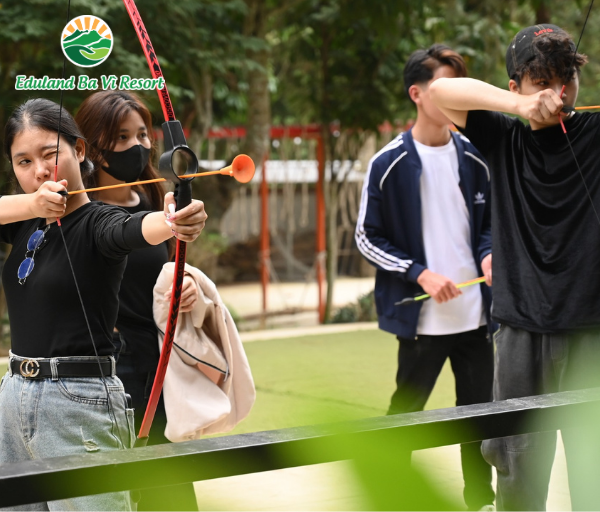
Archery — developing patience, concentration and body control
-
Grass sliding and zipline — overcoming personal limits in a safely managed environment
-
Traditional folk games — connecting with Vietnamese cultural heritage across age groups
Camp evening:
-
Open-air bonfire — singing, storytelling, sharing reflections
-
Outdoor BBQ — students prepare and serve their own food
-
Overnight in the community stilt house — a genuine collective living experience
🔗 See also: Student Experiential Tour — Eduland Ba Vi
3.2. Location — 60km From Hanoi, Genuine Natural Surroundings
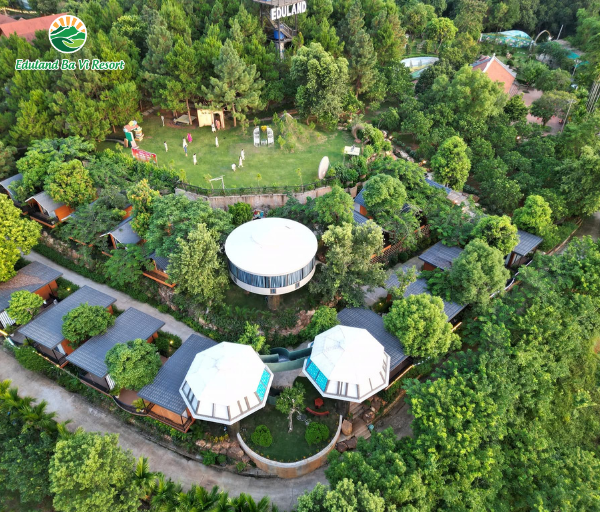
Eduland Ba Vi is located in Lien Bu Village, Minh Quang Commune, Ba Vi District — 60km via Thang Long Boulevard, approximately 1 hour 30 minutes by 45-seat coach.
The setting is genuinely distinctive: backed by Tan Vien Mountain, facing the Da River — clean air, a rich and diverse ecosystem and an original natural landscape that urban students rarely encounter.
This is not an artificial environment — this is a real outdoor setting where students can observe, learn and experience.
3.3. Facilities That Meet Summer Camp Standards
|
Facility
|
Eduland Ba Vi
|
|
Community stilt house
|
✅ 40–50 per house, air conditioning, en-suite facilities
|
|
Event hall
|
✅ 200 seats, full audio-visual system
|
|
Team building lawn
|
✅ Spacious, varied terrain
|
|
Swimming pool
|
✅ Outdoor, filtered, clean
|
|
Archery range
|
✅ With trained facilitator
|
|
Zipline and grass sliding
|
✅ With safety equipment
|
|
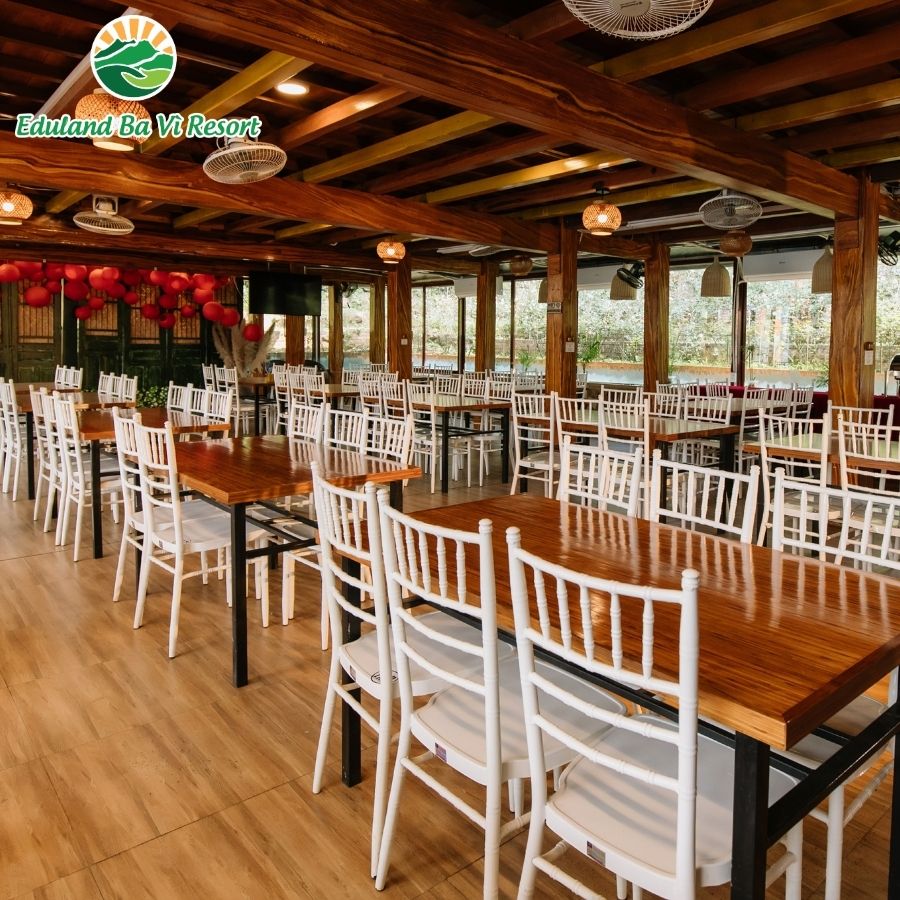
Kitchen and dining hall
|
✅ Group catering by set menu
|
|
Grounds
|
✅ Clearly bounded, adequately lit at night
|
3.4. Student Creative Experience Programme — Eduland's Signature Offering
Alongside the camping tour, Eduland Ba Vi delivers a Student Creative Experience Programme — combining play and learning through a modern experiential education methodology. The programme is built in modular form, allowing schools to select activities aligned with the term's learning theme and the students' age group.
🔗 See also: Student Creative Experience — Eduland Ba Vi
4. Sample 2-Day, 1-Night Summer Camp Itinerary at Eduland Ba Vi
📅 Day 1 — Arrive, Explore, Take on Challenges
|
Time
|
Activity
|
Skills Developed
|
|
8:00 AM
|
Depart from Hanoi
|
|
|
9:30 AM
|
Arrive at Eduland, opening ceremony in the event hall
|
Discipline, listening
|
|
10:00 AM
|
Team formation, camp mission briefing
|
Leadership, organisation
|
|
10:30 AM
|
Tent pitching
|
Practical skills, collaboration
|
|
12:00 PM
|
Clay pot rice cooking in groups
|
Task division, self-reliance
|
|
1:30 PM
|
Rest time
|
|
|
2:30 PM
|
Team building — challenge stations
|
Teamwork, problem-solving
|
|
4:00 PM
|
Archery / Grass sliding / Zipline
|
Focus, overcoming limits
|
|
5:30 PM
|
Free swim in the outdoor pool
|
Physical fitness
|
|
7:00 PM
|
Outdoor BBQ dinner
|
Self-service, communication
|
|
8:30 PM
|
Bonfire — singing, storytelling, sharing
|
Emotional expression
|
|
10:00 PM
|
Return to stilt house to sleep
|
Discipline, collective living
|
📅 Day 2 — Wrap Up and Head Home
|
Time
|
Activity
|
Skills Developed
|
|
6:00 AM
|
Morning exercise outdoors
|
Discipline, physical health
|
|
7:00 AM
|
Breakfast
|
|
|
8:00 AM
|
Tent packing, area clean-up
|
Environmental responsibility
|
|
9:00 AM
|
Comprehensive folk games session
|
Cultural heritage
|
|
10:30 AM
|
Closing ceremony, prize giving, group photos
|
Reflection, self-recognition
|
|
11:30 AM
|
Lunch
|
|
|
1:00 PM
|
Board coaches, depart for Hanoi
|
|
5. Common Mistakes When Choosing a Summer Camp Venue for Students
❌ Mistake 1: Choosing the cheapest option Low cost typically means poor facilities, insufficient staffing and an unstructured programme. The result is students who learn nothing, and schools that spend the trip managing problems.
❌ Mistake 2: Choosing based on attractive photographs online Many venues photograph beautifully but look very different in reality. Schools should visit in person or request real video footage before making a decision.
❌ Mistake 3: Not checking the activity programme in detail Ask directly: "What exactly is happening at each point in the day? Who is leading it? What will students learn?" Any centre that cannot answer these questions is not a genuine children's education centre.
❌ Mistake 4: No contingency plan for weather Summer afternoons in Ba Vi can bring heavy rain. A quality centre should have a weather contingency plan — indoor alternatives in the event hall or covered outdoor areas for activities.
❌ Mistake 5: Booking too late Summer is peak season for camps. Book at least 4–6 weeks in advance to guarantee your dates and sufficient accommodation for the whole group.
Conclusion
A student summer camp is an investment in children's development — not a cost to minimise. When schools and parents choose the right children's education centre against all 8 criteria above, a summer camp can deliver what an entire school year in the classroom cannot always provide: students who know who they are, know what they are capable of and have learned how to be with others in the very best way.
Eduland Ba Vi, with its camping and outdoor adventure tour and comprehensive experiential education programme, is ready to welcome student groups for summer 2026. Contact the team now to secure your dates before places run out.
Frequently Asked Questions (FAQ)
What age group is the student summer camp at Eduland Ba Vi suited for? The programme is suited to students from Year 1 through to Year 9 (ages 6–15). Each age group has its own activity module — primary students focus on exploration and folk games; lower secondary students have additional high-intensity team building, archery and zipline sessions.
What activities are included in the camping and outdoor adventure tour at Eduland Ba Vi? The programme includes: tent pitching, outdoor clay pot rice cooking, lawn team building, archery, grass sliding, zipline, traditional folk games, a bonfire evening, an outdoor BBQ and an overnight stay in the community stilt house. Schools can adjust the programme to suit their time frame and specific goals.
How far in advance should a summer camp at Eduland Ba Vi be booked? At least 4–6 weeks in advance, particularly during June–August when summer camp demand peaks. Contact hotline 0399.131.135 to check availability and receive a group quote.
Does Eduland Ba Vi help design a customised camp itinerary? Yes. The Eduland team works with schools to design a programme aligned with the number of days, the students' age group and specific educational goals — at no additional charge when a contract is signed.
How much does a student summer camp at Eduland Ba Vi cost? Pricing depends on the number of students, the number of nights and the package selected. Contact hotline 0399.131.135 or email edulandbavi@gmail.com for a detailed all-inclusive quote.
📍 Eduland Ba Vi Resort
📞 Hotline: 0399.131.135
🌐 Website: https://edulandbavi.vn
✉️ Email: edulandbavi@gmail.com
🚩 Address: Lien Bu Village, Ba Vi Commune, Hanoi