When should businesses organise a company trip or corporate retreat for the best energy recovery results? Analysing the golden timing for company holidays.
There is a question that very few businesses actually stop to answer scientifically: what is the ideal time of year to organise travel for employees?
Most companies still choose the timing of a corporate trip based on convenience — year end when work "quiets down a little", or summer because "the weather is nice". But when viewed through the lens of workplace energy cycles, organisational psychology and burnout research, the real answer is far more complex — and far more interesting.
This article examines when a business should organise travel and retreats for employees to achieve the greatest possible energy recovery — drawing on research into work energy cycles and practical experience from organising events at businesses across Vietnam.
1. Why Does the Timing of a Corporate Trip Matter So Much?
Many people assume it is simple: just give employees time off, take them somewhere enjoyable, and that is enough to "recharge the batteries". But organisational psychology research shows the opposite: the effectiveness of energy recovery depends heavily on timing — not merely on whether the trip happens at all.
Burnout researcher Christina Maslach, who laid the foundations for the concept of "occupational burnout", found that human work energy does not decline steadily over time — it hits specific breaking points, where accumulated stress crosses a threshold the individual can no longer sustain. Organising travel precisely at these breaking points delivers a far greater recovery effect than scheduling it arbitrarily around the administrative calendar.
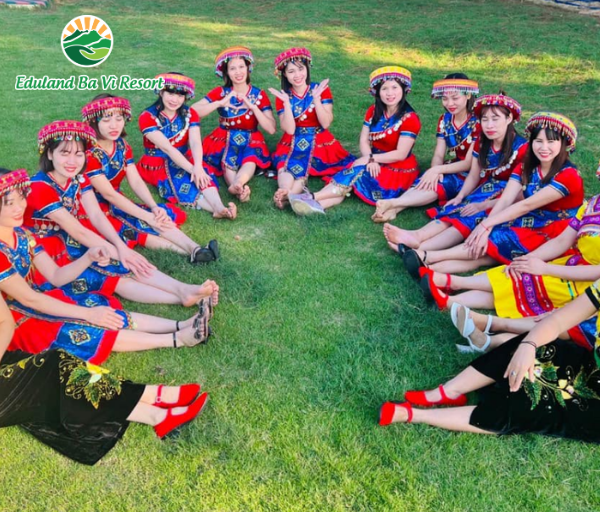
2. Four Golden Moments to Organise a Company Trip
⏰ Golden Moment 1: Immediately After a Peak Project Period or Business Season
This is the most effective timing — yet the one fewest businesses use correctly. Right after a major project concludes, or a peak business season closes (for example: after Tet for retail, after exam season for education, after a product launch for tech companies) — this is exactly when the team's energy is at its lowest and most in need of replenishment.
Why it works: The human body and mind operate on a "tension–release" model. When rest arrives immediately after a period of high stress, the recovery effect is significantly stronger than when rest arrives at a random point unrelated to the actual work cycle.
Note: Do not wait too long after a project ends — ideally within 2–4 weeks, while the sense of "relief at completing it" is still present, before the team is pulled into the next project.
>> Read more about Eduland Ba Vi here.
⏰ Golden Moment 2: Mid-Year — The Classic Energy Breaking Point
Research into annual work rhythms shows that most employees experience a distinct "energy dip" around June–July — after six consecutive months of work, and before entering the second half of the year with pressure to hit annual targets.
This is why mid-year corporate trips (June–August) are popular for more than just "nice weather" — they genuinely coincide with the biological point at which employees most need recovery.
Supporting data: Gallup's Employee Engagement surveys, tracked across quarters year after year, consistently show Quarter 3 (July–September) recording the lowest engagement levels of the year — exactly the point at which a business should intervene with recovery-focused activities.
⏰ Golden Moment 3: Before an Upcoming Peak Period
A strategy rarely discussed but remarkably effective: organising travel not as a "reward" after finishing something difficult, but as energy preparation before entering an upcoming period of difficulty.
Example: a business that knows Q4 will be its peak season (retail, e-commerce, logistics) organises a retreat at the end of Q3 — helping the team enter the high-intensity period with a "full energy tank" rather than one already depleted.
The psychological principle: This applies the concept of "burnout prevention" rather than "burnout recovery" — intervening before a problem occurs is always more effective than addressing it afterwards.
⏰ Golden Moment 4: After Major Organisational Change
A merger, restructuring, a change in leadership, an office relocation, a communications crisis that has just been resolved — any major period of organisational upheaval creates accumulated psychological stress for employees, even if their day-to-day tasks have not changed much.
After periods like these, a travel trip does more than restore individual energy — it plays an important role in repairing collective morale, rebuilding trust and re-establishing team cohesion after disruption.
3. Common Mistakes Businesses Make Around Trip Timing
❌ Mistake 1: Waiting Until Year End "Because That's Tradition"
Many businesses default to organising a corporate trip in December simply because "that's what we always do". But year end usually coincides with the final push to hit targets, close the books and prepare reports — the team is not psychologically free to actually "rest", and instead goes through the motions with their minds still on unfinished work.
❌ Mistake 2: Choosing Dates Randomly, Unrelated to the Work Cycle
Choosing a date based on when the event hall happens to be available or when room rates are cheapest — without considering where the team actually sits in its stress cycle — causes the trip to lose most of its recovery value, despite the significant expense involved.
❌ Mistake 3: Waiting Until Clear Signs of Burnout Appear
By the time employees are already showing visible signs of burnout — slower work, frequent sick leave, negative attitudes — organising a trip becomes damage control rather than genuine recovery. The most effective approach is prevention: scheduling in advance, aligned with the work cycle, rather than waiting for a problem to appear first.
4. How Often Is Enough? Once or Multiple Times a Year?
There is no fixed number that suits every business — but based on energy recovery principles, the following framework is a useful reference:
|
Business Size
|
Recommended Frequency
|
Format
|
|
Startup, SME (< 50 people)
|
1–2 times per year
|
One large mid-year trip + smaller quarterly bonding activities
|
|
Mid-size business (50–200 people)
|
1 large trip per year
|
Combine travel with a strategy conference
|
|
Large corporation (>200 people)
|
1–2 times per year, by department
|
Organise separately by team for easier management
|
General principle: One trip organised at the right time delivers far greater recovery value than two trips organised carelessly at the wrong moments.
5. Signs That a Team Needs to "Recharge"
Before deciding on a specific date, businesses can watch for the following signals from their teams:
-
A sharp increase in sick leave compared with previous months
-
A decline in performance even though workload has not changed
-
The office atmosphere becomes noticeably quieter, with less interaction between team members
-
An increase in negative feedback in internal surveys (if conducted)
-
A rising resignation trend among key personnel
When these signals appear together, it is a clear signal: the team needs a break to recover — sooner rather than later, rather than waiting for the next scheduled holiday.
.png)
6. Matching the Right Timing With the Right Type of Retreat
Timing is only half the equation — the format of the trip also needs to match its recovery purpose:
If the goal is purely physical and mental recovery: Prioritise natural surroundings and gentle, relaxing activities — swimming, afternoon tea, quiet spaces for genuine rest rather than a packed schedule.
If the goal is recovery combined with team bonding: Combine a restful setting with light team building activities — not too high intensity, to avoid adding further fatigue, but enough to create interaction and connection.
If the goal is preparing the team mentally for the next phase: Combine rest with a short strategic sharing session — not a tense meeting, but an open space for leadership to inspire the team ahead of the next phase, delivered within a relaxed setting.
Destinations near Hanoi with genuine natural surroundings — such as the Ba Vi region — typically meet all three of these goals well: close enough not to lose significant travel time, with enough natural space to create a genuine recovery effect.
Conclusion
The question "when should a business organise travel for its employees" does not have a single answer that fits every organisation — but there are clear, evidence-based principles worth following: immediately after a peak period, at the mid-year energy dip, before an upcoming challenging period, or after major organisational disruption.
What matters most is not whether a trip happens at all — it is whether it happens at the right time, when the team genuinely needs it and can extract the maximum possible recovery value from the experience.
A corporate trip scheduled at the right moment is not simply a perk — it is a strategic management decision, with direct consequences for productivity, engagement and the mental wellbeing of the whole team in the months that follow.
.png)
Frequently Asked Questions (FAQ)
What time of year is best for organising employee travel? There is no single fixed time that suits every business — the ideal timing depends on each organisation's own work cycle. That said, the most effective moments are typically immediately after a peak project period, around mid-year (June–August) when team energy tends to dip, or right before entering an upcoming high-intensity period.
Why isn't organising a year-end trip necessarily the best choice? Year end usually coincides with the final push to hit targets and close out reports, making it hard for employees to genuinely relax even while technically on a trip. Energy recovery is significantly more effective when the trip falls during a period with less work pressure.
How often should a small business organise company travel? For businesses under 50 people, 1–2 times a year is reasonable: one larger mid-year trip combined with smaller quarterly bonding activities to sustain team morale throughout the year.
How can we tell if our team needs a rest to recharge? Signals to watch for include: rising sick leave, declining performance despite unchanged workload, a quieter office atmosphere and increased resignations among key staff. When these signals appear together, it is a signal to organise a retreat sooner rather than later.
What type of trip best optimises energy recovery for employees? It depends on the specific goal: for purely physical and mental recovery, prioritise natural surroundings and gentle relaxation; for recovery combined with team bonding, combine a restful setting with light team building activities in a natural environment.
📍 Eduland Ba Vi Resort
📞 Hotline: 0399.131.135
🌐 Website: https://edulandbavi.vn
✉️ Email: edulandbavi@gmail.com
🚩 Address: Da Chong Village, Ba Vi Commune, Hanoi