Experiential travel for children delivers 10 development benefits: life skills, thinking, emotional growth. Eduland Ba Vi – trusted educational experience near Hanoi!
At a time when children spend the majority of their day with phones, tablets and packed study schedules, experiential travel for children is emerging as one of the most effective educational interventions that parents and schools can provide.
Not every trip qualifies as experiential travel. Taking children to a resort and letting them swim all day is rest. Experiential travel for children has a more specific purpose: placing children in real-world environments where they learn, take on challenges, fail and grow in ways that no classroom can replicate.
This article examines 10 specific benefits that experiential travel delivers for children's development — grounded in scientific research and linked to the real activities delivered at Eduland Ba Vi, one of the most respected educational experiential destinations near Hanoi.
1. What Is Experiential Travel for Children? How Does It Differ From Conventional Travel?
Experiential travel for children is a form of travel in which children are not passive observers — they are active participants in real learning, creative and connective activities.
|
|
Conventional Travel
|
Experiential Travel for Children
|
|
Child's role
|
Observer
|
Participant, practitioner
|
|
Purpose
|
Entertainment, rest
|
Skill development, cognitive growth
|
|
Outcome
|
Enjoyment — fades within days
|
Skills and memories — lasting for years
|
|
Environment
|
Passive, being served
|
Active, self-directed, self-resolving
|
|
Programme
|
Unstructured free time
|
Clear educational objectives
|
This is why many education specialists worldwide view experiential travel not as "going out to play" but as "learning outside the classroom" — an essential component of any child's holistic development programme.
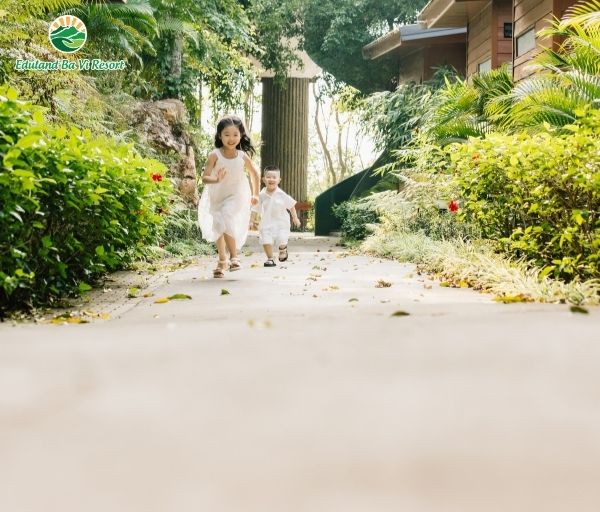
2. Ten Benefits of Experiential Travel for Children's Holistic Development
🌱 Benefit 1: Building Self-Reliance
At home, children are typically cared for in every small detail. On an experiential travel programme, children must fold their own blankets, prepare their own things, manage their own meals and organise their own time — often for the first time in their lives.
Developmental psychologist Lev Vygotsky described this as the "Zone of Proximal Development": children learn fastest when placed in situations that are challenging yet safe — precisely what a summer camp and nature immersion programme provides.
At Eduland Ba Vi: Students pitch their own tents, cook clay pot rice in groups and divide their own responsibilities — no teacher does it for them; facilitators support only when genuinely needed.
🔗 See also: Camping and Outdoor Adventure Tour at Eduland Ba Vi
🌱 Benefit 2: Developing Team Spirit and Collaboration
In the classroom, "teamwork" often means sitting at the same table for a group assignment. In experiential travel for children, teamwork is real — when the whole group must pitch a tent together before dark, or complete a challenge station together for their team to score points.
Real pressure creates real collaboration. When a child learns that their success depends on others — and that their failure affects others — that is a lesson in collective responsibility that no textbook can write.
At Eduland Ba Vi: Multi-station parallel team building, tug of war and group challenge stations force students to delegate, coordinate and trust one another.
🌱 Benefit 3: Increasing Self-Confidence and Overcoming Personal Limits
Research from the University of Colorado (2019) found that children who engage in physical challenges in natural environments — climbing, navigating obstacles, trying things for the first time — score significantly higher on self-confidence measures than peers without these experiences.
When a child who is afraid of heights rides a zipline for the first time and shouts with excitement rather than fear — not because anyone forced them, but because they overcame it themselves — that is a moment that changes how a child sees themselves.
At Eduland Ba Vi: Zipline, grass sliding and archery — each activity is a manageable personal challenge, with facilitators ensuring safety while leaving the decision to step forward entirely with the child.
🌱 Benefit 4: Developing Emotional Intelligence (EQ)
Experiential travel for children places students in complex emotional situations: missing home during a first overnight stay in a stilt house, disappointment at losing a game, elation when the team wins, pride at cooking a meal themselves for the first time.
These emotions — when experienced in a safe, supported environment — help children learn to identify, express and regulate their own feelings. This is the foundation of emotional intelligence (EQ) — identified by researcher Daniel Goleman as a stronger predictor of long-term success than IQ.
At Eduland Ba Vi: The evening bonfire includes a sharing circle — students are encouraged to talk about what they enjoyed, what they found difficult and what they learned during the day.
🌱 Benefit 5: Connection With Nature — The Foundation of Environmental Awareness
Research by the International Union for Conservation of Nature (IUCN) shows that children who have direct nature experiences during their early years are three times more likely to grow into adults who actively care about the environment compared with children who grow up primarily in urban settings.
When children see the Da River actually flowing, hear the birds of Ba Vi forest in the morning, and understand that the rice in their bowl was cooked over a fire from grain — not from a microwave and a polystyrene container — they begin to understand that they are part of the natural world, not observers standing outside it.
At Eduland Ba Vi: Guided tours of the grounds, observation of the Da River ecosystem and cooking with fresh local ingredients all reinforce this direct nature connection.
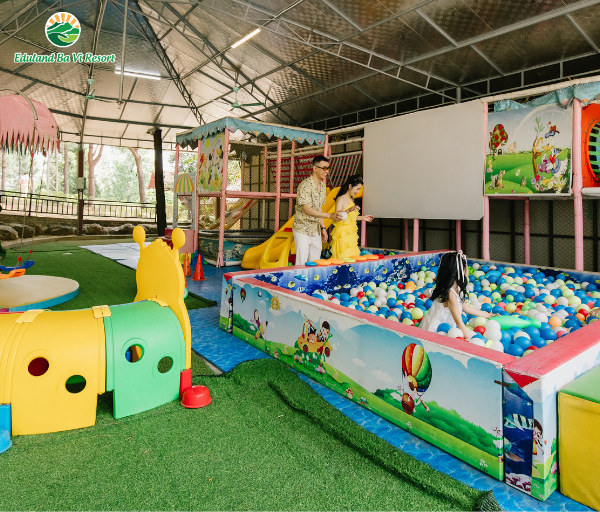
🌱 Benefit 6: Strengthening Problem-Solving Thinking
In nature and experiential environments, there are no ready-made answers. When a team cannot complete a challenge station because their approach is wrong, the students must discuss, adjust and try again. This is critical thinking and problem-solving practised in a genuinely real context.
Research from the US Educational Resources Information Centre (ERIC) found that children who participate in experiential education programmes score 28% higher on problem-solving assessments than those following purely theoretical learning.
At Eduland Ba Vi: Team building stations are deliberately designed without a "shortcut" — every team must try multiple approaches before finding the right one.
🌱 Benefit 7: Building Shared Memories — The Foundation of Lasting Friendship
Social psychology confirms that the strongest relationships are built through shared experiences — particularly those involving challenge, uncertainty and heightened emotion. This is why people who have overcome a difficult experience together often bond more deeply than those who have simply sat next to each other in a classroom.
The bonfire that evening, the tent that finally stood up just before dark, the first clay pot meal cooked by their own hands — these memories become "shared stories" that students will still be recalling together years later.
At Eduland Ba Vi: Every element of the programme is deliberately designed to create memorable moments: the first zipline ride, the self-grilled BBQ by firelight, the bonfire night in the mountain air of Ba Vi.
🌱 Benefit 8: Developing Adaptability and Flexibility
Real life does not follow a script. When rain interrupts a team building session mid-activity, when the food is different from what a child is used to, when 40 people must share a stilt house for the night — children practise adapting to circumstances rather than waiting for everything to be perfect.
Adaptability — known in developmental psychology as "resilience" — is a skill that employers worldwide are valuing more highly each year. And it cannot be taught through words; it can only be formed through genuine experience.
At Eduland Ba Vi: Every small change in the programme becomes a learning opportunity: "When conditions change, how do we adjust?"
🌱 Benefit 9: Cultural Connection and National Identity
At a time when children are growing up immersed in international content across social media, experiential travel for children rooted in local culture offers something invaluable: helping children understand and appreciate their own national identity.
When students play ô ăn quan, take part in tug of war and sack racing — games that generations of Vietnamese children have played for centuries — they are not just having fun. They are connecting with their own history and culture in the most natural way possible.
At Eduland Ba Vi: Traditional Vietnamese folk games are woven into every experiential programme — from tug of war to sack racing, from clay pot cooking to traditional storytelling from the Ba Vi region.
🌱 Benefit 10: Improving Physical and Mental Health
According to the World Health Organisation (WHO), children aged 5–17 need at least 60 minutes of moderate to vigorous physical activity every day. In reality, most urban students fall significantly short of this standard, due to heavy academic schedules and heavy screen use.
A 2-day experiential travel programme at Eduland can add many genuine hours of physical activity: running, swimming, climbing, archery, ziplining — in a natural environment where cortisol (the stress hormone) falls and endorphins (the happiness hormone) rise.
Research from the University of Michigan (2008) confirmed that just 20 minutes in a natural environment is enough to improve concentration and reduce anxiety in children.
At Eduland Ba Vi: Outdoor filtered swimming pool, open lawn, zipline and grass sliding — every activity is an opportunity for real movement in clean mountain air.
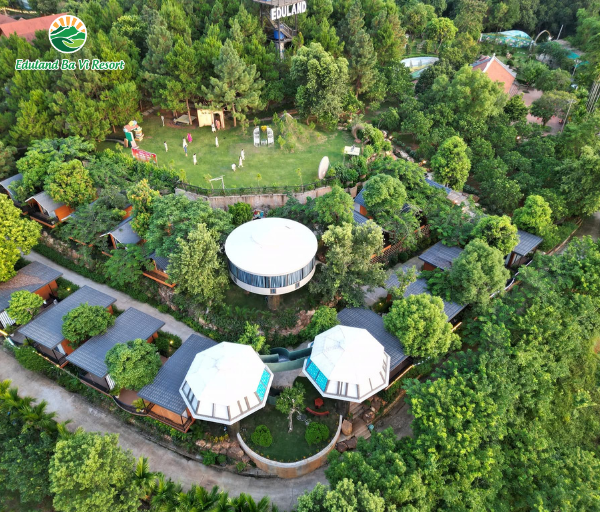
3. Why Is Eduland Ba Vi the Ideal Destination for Children's Experiential Travel?
Not every destination can deliver all 10 benefits above. The setting needs to be right, the programme needs to be right and the team needs to be right.
The Setting: Original Nature Beside the Da River
Eduland Ba Vi is located in Lien Bu Village, Minh Quang Commune, Ba Vi District — 60km from Hanoi, backed by Tan Vien Mountain and facing the Da River. This is not an artificial landscape — it is the original ecosystem of Vietnam's upland region, where the air, the scenery and the sounds of nature are entirely real.
The Programme: Structured Camping With Educational Purpose
The camping and outdoor adventure tour and the student creative experience programme at Eduland are designed by an experienced team, with a specific educational objective behind every activity — not unstructured free play, but purposeful learning through guided experience.
The Team: Professional Facilitators Experienced With Children
Eduland's facilitators are trained to work with large student groups, patient across all age groups and skilled at turning every situation — including minor setbacks — into a learning moment for the children.
🔗 See also: Student Creative Experience Tour — Eduland Ba Vi
4. Practical Advice for Parents: How to Choose the Right Experiential Trip for Your Child
✅ Ask about the programme before booking: "What specifically happens at each point in the day? What will my child learn from each activity?"
✅ Check the supervision ratio: The ideal ratio is 1 facilitator per 10–15 students — ensuring every child receives the right level of support and attention.
✅ Prioritise genuine natural surroundings: Do not choose a resort with "artificial trees and a tiled pool". Choose a setting with enough genuine natural environment that children can have real emotional responses to the world around them.
✅ Have a conversation with your child after the trip: The dinner table after the trip is a golden opportunity. Ask: "What surprised you most? What was the hardest thing? What did you learn?" These conversations reinforce the learning and deepen what children have already experienced.
🔗 See also: Camping and Outdoor Adventure Tour — Eduland Ba Vi
Conclusion
Experiential travel for children is not a luxury or an optional extra — it is one of the highest-return investments possible in a person's development. The ten benefits above — from self-reliance and problem-solving through emotional intelligence, cultural connection and physical health — cannot be achieved through classroom learning alone.
Eduland Ba Vi is providing the environment and programme to make those benefits real — just 60km from Hanoi, within the original natural landscape of the Ba Vi mountains.
Let this summer be the summer your child genuinely learns something new.
Frequently Asked Questions (FAQ)
How is experiential travel for children different from an ordinary trip? Experiential travel is designed around specific educational goals: children do not just play — they practise skills, interact directly with their environment and reflect on what they have learned. This is the fundamental difference from purely recreational or resort-based travel.
What age group is experiential travel at Eduland Ba Vi suited for? Eduland serves students from ages 5 (kindergarten) through to 15 (lower secondary). The programme is adapted by age: kindergarten and primary students focus on gentle exploration; lower secondary students have additional high-intensity activities including zipline, archery and strategic team building.
How far is Eduland Ba Vi from Hanoi? Approximately 60km via Thang Long Boulevard — around 1 hour 30 minutes by coach or private vehicle. This is the ideal distance for a 1-day or 2-day, 1-night experiential programme.
Can parents join the experiential travel programme with their child? Yes. Many families choose a family package at Eduland where parents join selected activities with their children and stay overnight. Parents stay in bungalows while students sleep in the community stilt house — combining family closeness with the independent experience children need.
Can schools integrate experiential travel with the term's academic curriculum? Absolutely. The Eduland Ba Vi team supports schools in designing an experiential programme aligned with the term's learning theme — for example, linking an ecology unit with a guided nature tour, or a cultural heritage unit with traditional folk games. Contact 0399.131.135 for a consultation.
📍 Eduland Ba Vi Resort
📞 Hotline: 0399.131.135
🌐 Website: https://edulandbavi.vn
✉️ Email: edulandbavi@gmail.com
🚩 Address: Lien Bu Village, Ba Vi Commune, Hanoi